
The Battle at Inverboyndie : part 2
The Evidence
There are a number of medieval sources covering events in this period, and there are often different versions of these sources.
Of the early medieval sources included by the 20th century Scottish historian Alan Orr Anderson in Early Sources of Scottish History none mention a battle at Inverboyndie or any in 1004.
The Chronicle of the Kings of Scotland, as included in the Early Sources of Scottish History, under the entry for 962 C.E., records the death of Indulf battling Norwegians at Invercullen.
The entry in the New Statistical Account entry for Cullen records that event.
Rev Anderson places the battle in 1004 during the reign of Malcolm II because of his connexion with the patron saint of the parish, and a taste for building or rebuilding churches in acknowledgement of his victories or damaged in his wars.
According to The Early Sources of Scottish History, Malcolm II only became King of Scotland in 1005.
John Fordun, the 14th century Scottish historian, in his Chronicle of the Scottish Nation states that Malcolm became king in 1004, and within a few days of his coronation defeated a Norwegian army in the north. On three occasions he defeated Danes and once they were defeated by natives when he was not present.
Aberdeenshire Historic Environmental Records notes that the existing ruin of St Brandan’s is 17th century and is possibly on the site of an earlier church.
The Banffshire Field Club Transactions 1880-1883 records that when the north wall was moved to extend the churchyard, large bones and skulls were found in a broad trench.
Rev Anderson stated that the mound of bones was 30 yards from the churchyard and north of the road. David Grieve noted that skulls were removed from a mound traditionally said to be over a trench .
A field investigation noted on the Ordnance Survey index card dated 2.10.61 states that there was no trace of a mound or trench.
A number of the skulls from the mound are held by the National Museum of Scotland. They have not been dated or studied.
The New Statistical Account is the earliest record of the field names.
Reproduced with the permission of The University of Aberdeen ABDUA:64539. ©University of Aberdeen (CC-BY)
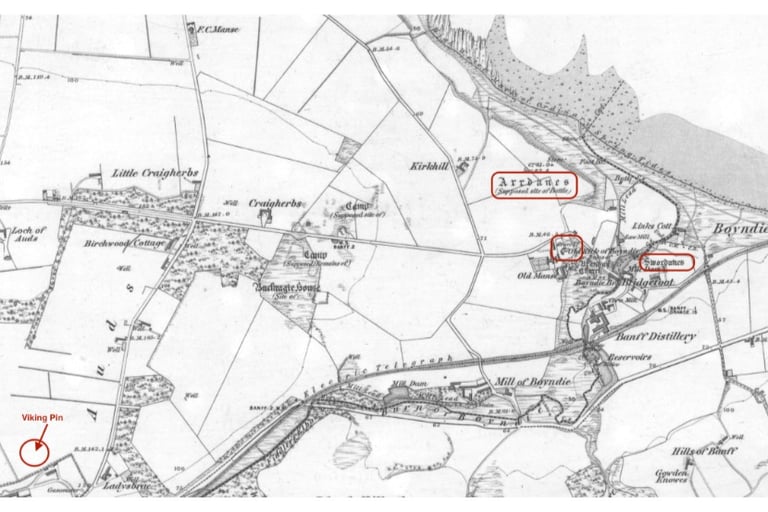
The description of the find spot on the record would place it on Arrdanes, however the map shows the find spot a mile and half away at Ladysbridge.
Ordnance Survey Six-inch 1st edition 1843-1882 Banffshire sheet IV Printed 1871
Reproduced with the permission of the National Library of Scotland (CC-BY (NLS))
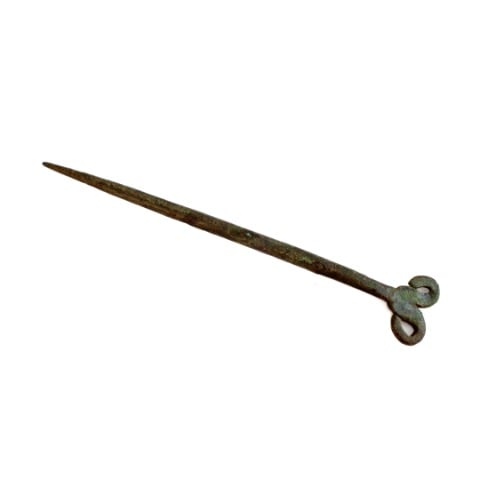
A cast bronze pin found in 2006, is recorded on Aberdeenshire Historic Environmental Records, as a "Viking pin", but its date is uncertain. The hipped shaft being associated with pins from Scotland and Ireland.
Contact
contact@banffshirethings.uk
© 2026. All rights reserved.