The Battle at Inverboyndie
The Evidence
There are a number of medieval sources covering events in this period, and there are often different versions of these sources.
Of the early medieval sources included by the 20th century Scottish historian Alan Orr Anderson in Early Sources of Scottish History none mention a battle at Inverboyndie or any in 1004.
The Chronicle of the Kings of Scotland, as included in the Early Sources of Scottish History, under the entry for 962 C.E., records the death of Indulf battling Norwegians at Invercullen.
The entry in the New Statistical Account entry for Cullen records that event.
Rev Anderson places the battle in 1004 during the reign of Malcolm II because of his connexion with the patron saint of the parish, and a taste for building or rebuilding churches in acknowledgement of his victories or damaged in his wars.
According to The Early Sources of Scottish History, Malcolm II only became King of Scotland in 1005.
John Fordun, the 14th century Scottish historian, in his Chronicle of the Scottish Nation states that Malcolm became king in 1004, and within a few days of his coronation defeated a Norwegian army in the north. On three occasions he defeated Danes and once they were defeated by natives when he was not present.
The Annals of Banff mention a charter granting the church at Inverboyndie to the monks of Arbroath by Matthew, the Bishop of Aberdeen (1178-1199)
Aberdeenshire Historic Environmental Records notes that the existing ruin of St Brandan’s is 17th century and is possibly on the site of an earlier church.
The Banffshire Field Club Transactions 1880-1883 records that when the north wall was moved to extend the churchyard, large bones and skulls were found in a broad trench.
Rev Anderson stated that the mound of bones was 30 yards from the churchyard and north of the road. David Grieve noted that skulls were removed from a mound traditionally said to be over a trench .
A field investigation noted on the Ordnance Survey index card dated 2.10.61 states that there was no trace of a mound or trench.
A number of the skulls from the mound are held by the National Museum of Scotland. They have not been dated or studied.
The New Statistical Account is the earliest record of the field names.
Discussion
The location of the mound of skulls.
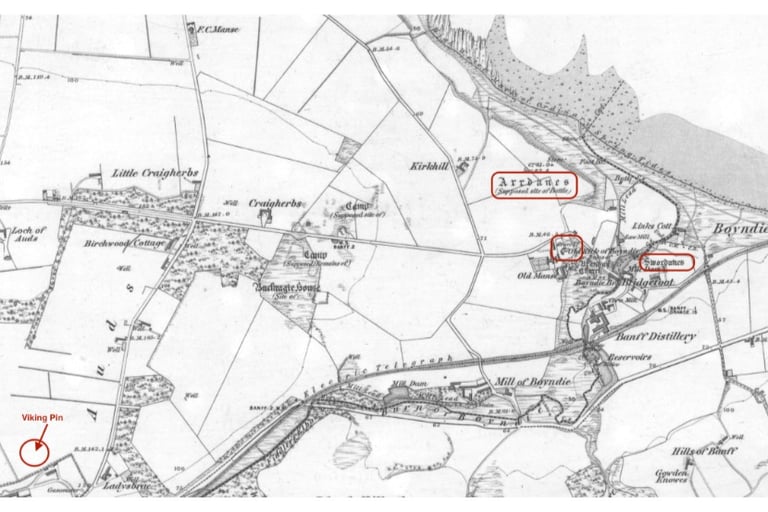
The 1766 survey shows the road where it is today, and the churchyard wall set back from the road. The northern wall now lies beside the road. It has been moved just under 30 yards from the original.
The Banffshire Field Club description of the site of the trench of bones and the one by Rev Anderson regarding the mound appear to differ. Were there two different bone filled areas?
Or just one whose position was incorrectly noted?
If the mound was south of the road, then it would make sense for it to be excavated as it now lay either in the extended churchyard or under the new north wall.
If it lay 30 yards north of the wall, why would the extension of churchyard require the mound to be excavated?
The area marked as Arrdanes has two distinct areas. To the west it rises sharply from the road to form a large plateau, to the east it drops sharply to form a smaller area, which becomes boggy as it reaches the river. It is unclear from Rev Anderson’s description which part the mound was in.
The fields
The name of fields seems unusual. Are any other examples where the deployment an enemy force’s units was recorded in place names?
The idea of the 2 divisions in separate fields, widely separated by a valley and river would make little sense.
The finds
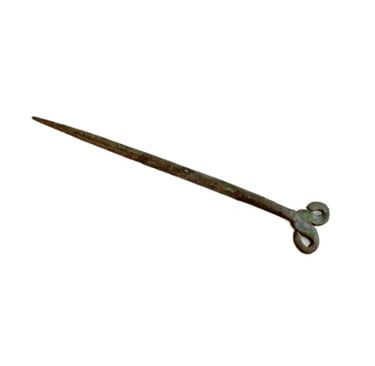
The pin is an intriguing find, whilst not found on Arrdanes, it was only a mile and half away.
Further investigation of this area may be useful.
Dating the skulls and other investigative work might establish the likelihood of them being associated with the battle.
Whilst The Banffshire Field Club was told of weapons and bones being found in the fields, none are held by the Aberdeenshire Museum Service or by Banff Museum. Are there any held in another collection or in private hands?
The records
None of the early records specifically mention a battle at Inverboyndie. John Fordun states King Malcolm defeated Norwegians in 1004, although this event is absent from the sources recorded by Alan Orr Anderson.
The 18th century maps do not mention the fields or a battle site, and some the 19th century maps do.
Were there several battles along this coastline, or just one remembered at different sites?
Reproduced with the permission of The University of Aberdeen ABDUA:64539. ©University of Aberdeen (CC-BY)
The description of the find spot on the record would place it on Arrdanes, however the map shows the find spot a mile and half away at Ladysbridge.
Reproduced with the permission of the National Library of Scotland (CC-BY (NLS)
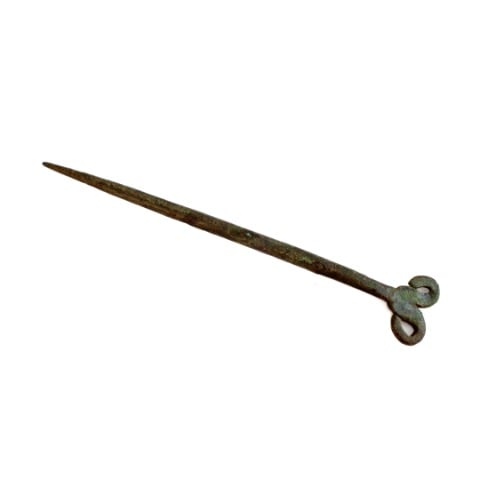
A cast bronze pin found in 2006, is recorded on Aberdeenshire Historic Environmental Records, as a Viking pin, but its date is uncertain. The hipped shaft being associated with Viking pins from Scotland and Ireland.
Contact
contact@banffshirethings.uk
© 2026. All rights reserved.